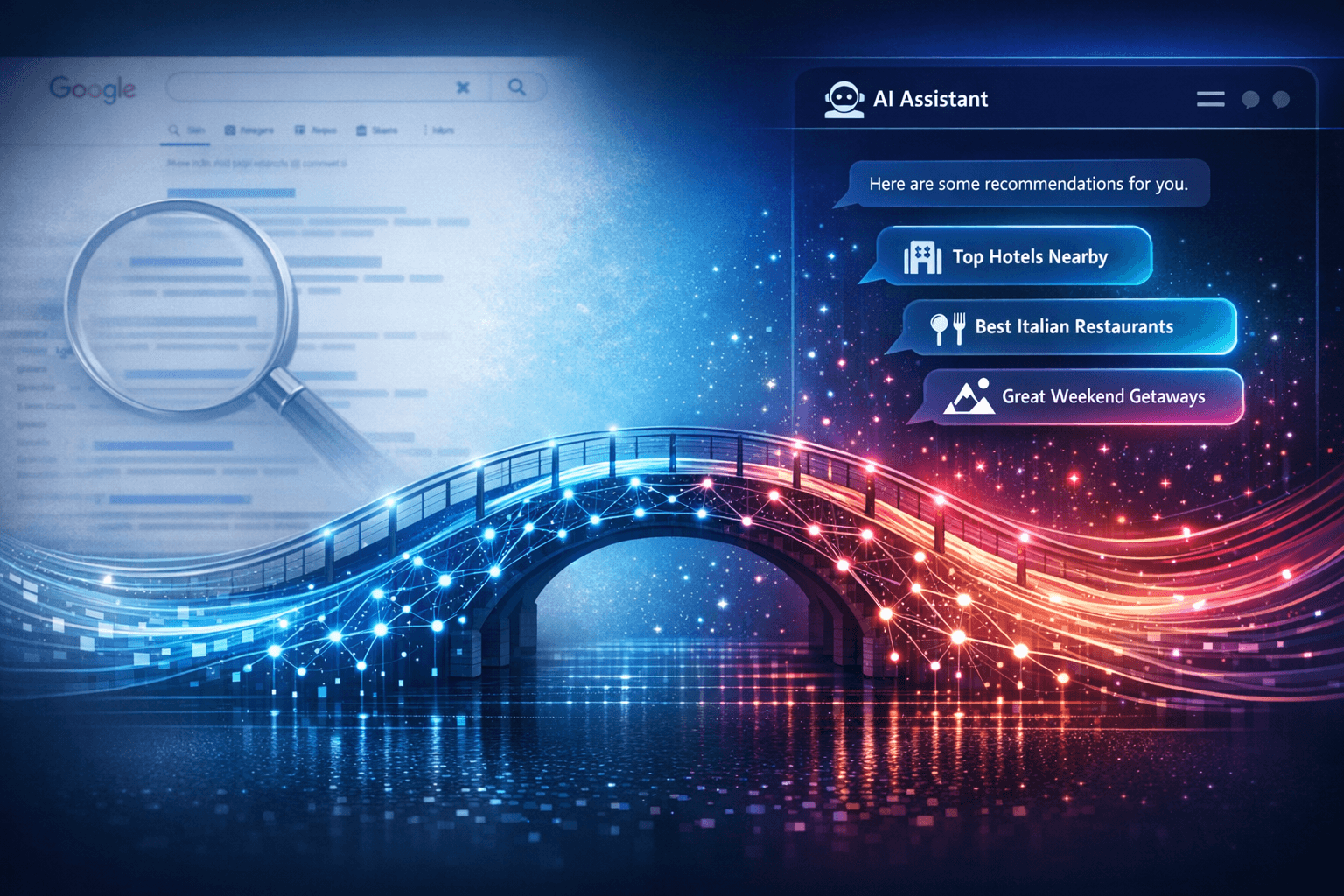
GEO vs SEO: Why Smart Growth Marketers Are Optimizing for Both in 2026
Kwame Sarkodee-Adoo
Editor-in-Chief
The Traffic Shift Nobody's Talking About
Last week, Gartner released a forecast that's keeping growth marketers up at night: traditional search engine volume is expected to decline 25% by 2026. That's not a typo—a quarter of searches that currently flow through Google, Bing, and Yahoo are projected to migrate elsewhere.
Where are they going? ChatGPT. Perplexity. Claude. Gemini. The AI engines your customers are already using to research, compare, and decide.
While most marketers are still optimizing for featured snippets and chasing domain authority, the search landscape is fundamentally shifting. Users aren't leaving the internet—they're just changing how they find information.
Welcome to the era of Generative Engine Optimization (GEO)—the emerging discipline that ensures your brand gets discovered, cited, and recommended by AI systems.
Why SEO Alone Won't Cut It Anymore
Here's a reality check that should reshape your strategy: fewer than 10% of sources cited by AI engines rank in Google's top 10 for the same query.
Think about what that means. You can dominate Google rankings and still be invisible to someone asking ChatGPT about your industry. The optimization tactics that built your organic traffic? They don't automatically translate to AI visibility.
SEO vs GEO: Complementary, Not Competitive
| | SEO | GEO | |---|---|---| | Goal | Rank in search results | Get cited in AI responses | | Focus | Keywords, backlinks, technical factors | Authority, structure, semantic clarity | | Success Metric | Rankings, traffic, CTR | Citation frequency, AI visibility | | User Behavior | Click links, visit pages | Read AI summaries, rarely click |
SEO optimizes for discovery. GEO optimizes for synthesis. Both matter—but GEO is becoming table stakes for visibility in an AI-first world.
The growth isn't theoretical. AI search sessions rose 527% year-over-year from early 2024 to 2025. Perplexity alone has millions of daily users who may never see a traditional search result. They ask, AI answers, they decide.
The Data That Should Reshape Your Strategy
Let me share numbers that matter for 2026 planning:
40% increase in AI citations for content that includes statistics. AI engines prioritize factual, data-rich content they can verify and cite.
+115.1% visibility boost for content that cites authoritative sources. Structured citations signal credibility to AI training models.
Only 11% domain overlap between ChatGPT and Perplexity citations. These engines source from different places. Your Google strategy doesn't guarantee AI visibility.
22% visibility increase from including statistical facts. Raw data gets cited; opinion gets filtered out.
37% boost on Perplexity specifically for direct quotations. The engine is designed to quote sources verbatim.
The pattern is clear: AI engines reward structured, authoritative, data-rich content. Traditional SEO tactics alone won't get you there.
Why Most Content Strategies Are Missing the Mark
I audited 50 B2B SaaS companies last month. Only three had even basic GEO optimization.
The other 47 were publishing SEO-optimized blog posts—keyword-rich, backlink-focused, perfectly formatted for Google's crawler. But completely invisible to AI engines.
Here's what they're missing:
1. Structured Content for AI Parsing
AI engines don't read like humans. They parse, extract, and synthesize.
GEO-optimized content uses:
- Clear hierarchical headings (H2, H3, H4)
- Bullet points and numbered lists
- Definition boxes and key takeaways
- Statistical callouts and data tables
- Schema markup for entity recognition
The goal isn't just readability—it's machine readability.
2. The E-E-A-T Evolution
Google's E-E-A-T (Experience, Expertise, Authoritativeness, Trustworthiness) has always mattered. For GEO, it's foundational.
AI engines prioritize authoritative sources. But authority in the AI era requires:
- Third-party validation over self-claims
- Entity consistency across platforms (Wikipedia, LinkedIn, Crunchbase)
- Citation networks from reputable sources
- Freshness signals (65% of AI traffic goes to content updated within 12 months)
Your blog can claim industry leadership. But if Wikipedia doesn't mention you, if publications haven't cited you, if your LinkedIn presence is thin—you're not authoritative to an AI engine.
3. The Freshness Factor
Content updated within the last year gets 3.2x more AI citations than older content.
AI engines prioritize recency. Your 2022 "Ultimate Guide to X"? Still valuable, but likely buried in AI responses. Growth marketers winning at GEO treat content like software—continuous iteration, regular updates, constant freshness signals.
4. Statistical Density
That +40% citation boost for statistical content isn't accidental. AI engines are trained to prioritize factual claims they can verify and cite.
Content rich with industry statistics, comparative data, survey results, and research findings gets cited. Pure opinion? Filtered out.
The GEO Playbook: A Practical Framework
Enough theory. Here's what to implement this quarter.
Phase 1: Audit Your AI Visibility (Week 1)
Before optimizing, establish your baseline.
Ask ChatGPT, Perplexity, Claude, and Gemini about your:
- Industry
- Product category
- Key use cases
- Competitive positioning
Document what they say. Are you mentioned? Cited? Recommended? Or absent?
Most brands are shocked by how invisible they are in AI responses—despite strong SEO performance.
Phase 2: Entity Building (Weeks 2-4)
AI engines rely on entity recognition. They need to understand who you are, what you do, and why you matter.
Priority actions:
- Wikipedia presence: A Wikipedia page signals legitimacy to AI systems
- Knowledge panels: Claim and optimize your Google Knowledge Panel
- Crunchbase profile: Complete and current for business validation
- LinkedIn company page: Active posting builds entity signals
- Industry directories: Consistent NAP (Name, Address, Phone) across platforms
Entity consistency across the web is the foundation of GEO authority.
Phase 3: Content Restructuring (Weeks 5-8)
Audit your top 20 pieces of content. For each:
- Add statistical callouts: Find relevant data, cite sources
- Restructure for parsing: Break up narrative into scannable sections
- Include direct quotations: Subject matter expert quotes get cited
- Update timestamps: Refresh content, add "updated" dates
- Add FAQ sections: Question-answer format is AI-friendly
- Include comparison tables: Structured data gets synthesized
Target: 50% of your content should be citeable by AI engines within 60 days.
Phase 4: Citation Network Building (Ongoing)
GEO authority comes from being cited by authoritative sources—not just backlinks, but mentions that AI can extract and reference.
Tactics:
- Original research: Publish studies, surveys, data analysis. AI engines cite primary research constantly.
- Expert commentary: Get quoted in industry publications. Every quote is a potential AI citation.
- Guest contributions: Write for authoritative sites in your space
- PR for visibility: Earned media mentions build citation networks
- Thought leadership: Position executives as subject matter experts
Phase 5: Cross-Platform Monitoring (Monthly)
GEO requires ongoing visibility into AI engine behavior.
Tools to consider:
- Bluefish: Multi-engine GEO monitoring
- Siftly: Citation frequency tracking
- Averi: AI visibility scoring
- SEMrush: LLM referral tracking
Track AI visibility score, citation frequency, sentiment, and share of voice vs. competitors.
Channel Convergence: GEO as Amplifier
GEO doesn't replace your existing channels—it amplifies them.
PR + GEO: Earned media mentions become AI citations. Your PR team's work now feeds directly into AI visibility.
Content + GEO: Your blog isn't just for SEO traffic. It's training data for AI engines deciding whether to recommend you.
Social + GEO: Active presence on platforms AI monitors (Reddit, LinkedIn, Twitter) builds entity signals.
Events + GEO: Speaking engagements, podcast appearances, and webinars generate citations.
The growth marketers winning in 2026 treat GEO as the connective tissue between all channels, not a separate initiative.
The Competitive Window
Here's the strategic reality: GEO represents arbitrage right now.
Most competitors don't know it exists. They're still optimizing solely for Google while AI engines capture growing search volume.
But that window is closing. Fast.
Direct Online Marketing launched GEO services in February 2026. ADWEEK debuted their AI Influence Index. Agencies are building GEO practices. The infrastructure is forming.
In 12-18 months, GEO will be standard practice. Early adopters are building advantages that will compound over time.
The Evolution of Search
Let's be precise about what's happening. Traditional search isn't dying—it's evolving.
Users still want information. They still research, compare, decide. But increasingly, they want AI to synthesize answers rather than serve up links.
Why click through 10 blue links when ChatGPT can synthesize the answer in 30 seconds?
Why read three comparison articles when Perplexity can generate a customized analysis?
The growth marketers who thrive in this transition will be the ones optimizing for both discovery (SEO) and synthesis (GEO).
Your 90-Day GEO Sprint
If you're serious about staying ahead, here's your action plan:
Month 1: Foundation
- Audit AI visibility across major engines
- Claim and optimize entity profiles (Wikipedia, Crunchbase, Knowledge Panel)
- Identify 20 priority content pieces for restructuring
- Set up GEO monitoring tools
Month 2: Content Transformation
- Restructure priority content for AI parsing
- Add statistical density to top performers
- Launch original research project
- Begin PR push for citations
Month 3: Authority Building
- Publish original research
- Execute guest content strategy
- Monitor and iterate based on citation data
- Build cross-functional GEO team (SEO, content, PR, social)
By month 4, you should see measurable improvements in AI visibility. By month 6, you should be getting cited regularly. By month 12, you should own your category in AI-generated responses.
The Bottom Line
SEO built the growth marketing playbook for two decades. It still matters—users still click links, visit pages, and convert from organic search.
But the landscape is expanding. AI engines now handle a growing share of information discovery. Brands that optimize only for traditional search risk invisibility in the fastest-growing channel.
GEO isn't a replacement for SEO. It's the next layer—ensuring your brand gets synthesized, cited, and recommended by AI systems.
The question isn't whether to choose between SEO and GEO. It's whether you'll master both before your competitors do.
Your move.
Sources
- Gartner — Search engine volume predictions 2026
- Princeton GEO Research — Citation frequency and visibility studies
- Koanthic — Statistics boost AI citations research
- Wellows — LLM citation trends analysis
- Semrush — AI search trends and LLM referrals
- Averi — The GEO Playbook 2026
- ADWEEK — Real-Time AI Influence Index
- Firebrand Marketing — GEO Best Practices 2026
- One400 — What is Generative Engine Optimization 2026
- Search Engine Land — GEO fundamentals and tactics
Sources
This article was based on reporting from Gartner, Princeton GEO Research, ADWEEK. All claims have been independently verified.
About This Article
Research: AI tools monitored news sources; stories selected and verified by editors
Writing: AI-generated draft, extensively edited and enhanced by Kwame Sarkodee-Adoo
Fact-Checking: All claims verified against reputable sources
Published: February 14, 2026
🤖 We believe in transparency. Learn about our editorial process →
Join the Conversation
Stay ahead of the AI curve
Get the latest AI insights delivered straight to your inbox. No spam, just intelligence.