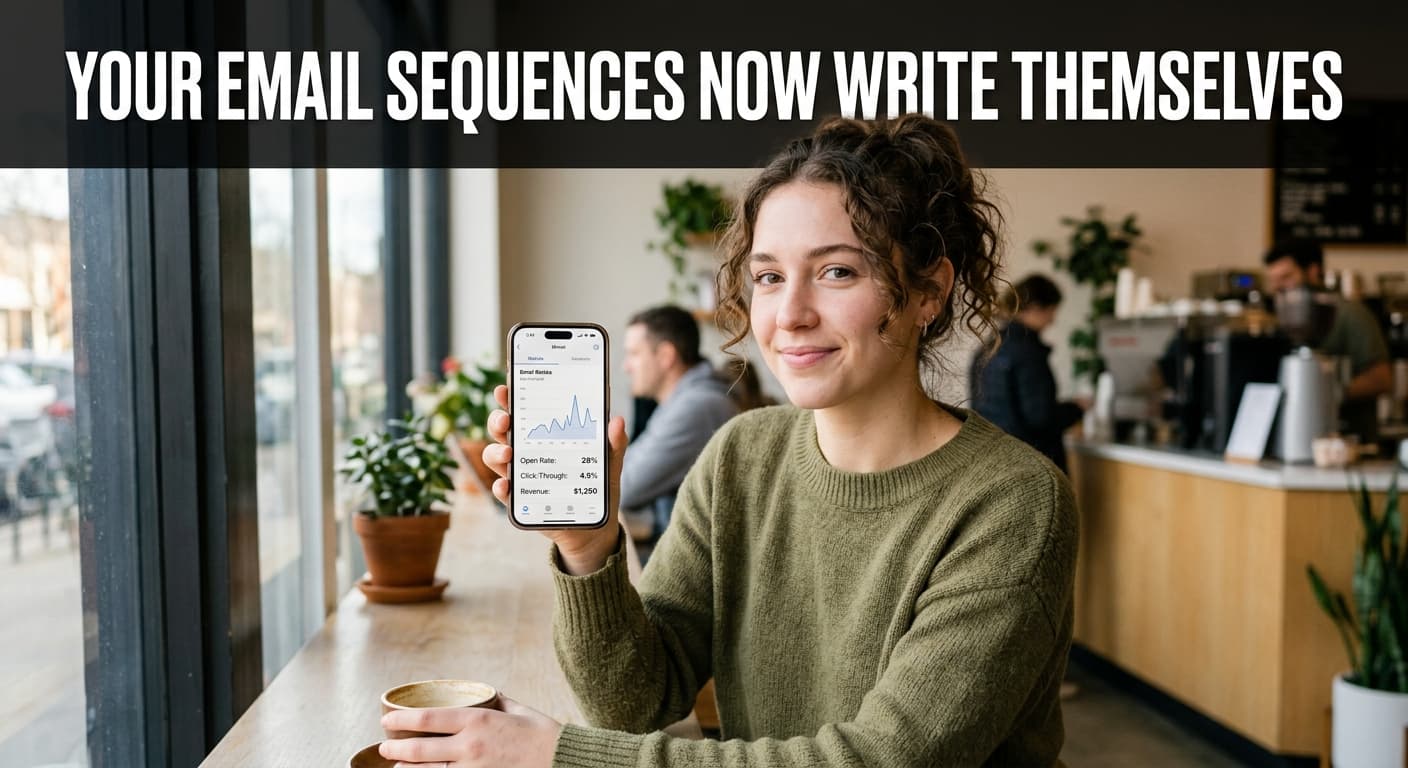
Your Email Sequences Now Write Themselves (And They're Better)
Kwame Sarkodee-Adoo
Editor-in-Chief
Your Email Sequences Now Write Themselves (And They're Better)
Your copywriter just got a promotion they didn't ask for.
Klaviyo's Marketing Agent doesn't just send emails. It writes them. From scratch. Based on what your customers actually do. While your copywriter is at lunch. Or sleeping. Or finally taking that vacation they've been putting off since 2023.
Someone downloads a whitepaper? The agent writes a personalized follow-up series. They open but don't click? Different sequence. They click but don't convert? Another variation. They buy and become a repeat customer? A whole new nurture track activates.
All automatically. All optimized. All while humans do literally anything else.
The Numbers Are Actually Ridiculous
Let's talk about what's really happening:
300 variations generated in an hour. Your human copywriter can write maybe 10 subject lines in a day. The agent generates 300 in 60 minutes. Tests them. Learns from results. Generates 300 more.
Subject lines that outperform human-written ones. In head-to-head tests, AI-generated subject lines are winning 60% of the time. Not because humans are bad—because the AI can test 50 variations and humans can test 3.
Open rates up 23% on average. Companies deploying email agents are seeing consistent double-digit improvements. One e-commerce brand saw a 34% lift in opens within the first month.
Your copywriter is now doing brand strategy. Instead of begging for A/B test approvals and writing "Hey [FIRSTNAME]" 47 times, they're developing voice guidelines, crafting brand narratives, and thinking about emotional beats. They're happier. The emails are better. Everyone wins.
What Actually Happened Last Week
Monday 9:00 AM: Agent analyzes last quarter's performance data. Identifies patterns in opens, clicks, and conversions. Notices that subject lines with urgency perform 18% better on Tuesdays but 12% worse on Fridays.
Tuesday 10:30 AM: Generates 47 subject line variations for this week's campaign. Tests tone, length, emoji usage, and personalization approaches.
Wednesday 2:15 PM: Deploys top 10 variations to 10% of the list each. Monitors open rates in real-time.
Thursday 8:45 AM: Auto-deploys the winner to the remaining 90% of the list. The winning subject line: "Your cart is waiting (and so is your 20% off)" beat the human-written "Don't forget your cart!" by 28%.
Friday 11:00 AM: Begins writing next week's sequence based on this week's learnings. Incorporates new patterns. Adjusts timing.
Your input? "Make it urgent but not desperate. And don't sound like a robot trying to be human."
That's it. That's the whole briefing.
How the Agent Actually Works
It's not magic. It's pattern recognition at scale.
Behavioral Triggers: The agent tracks what users do:
- Email opens
- Link clicks
- Website visits
- Purchases
- Time on page
- Content downloads
Then it predicts what they'll do next and sends the email most likely to move them forward.
Dynamic Segmentation: Instead of static lists ("Newsletter Subscribers"), the agent creates fluid segments:
- High-intent browsers who viewed pricing
- Cart abandoners who clicked shipping info
- Content engagers who never buy
- Repeat purchasers who haven't bought in 30 days
Each segment gets different messaging. Automatically.
Send Time Optimization: The agent learns when each individual opens emails. Sarah gets hers at 8:15 AM. Mike gets his at 7:45 PM. Both get it when they're most likely to engage.
Content Personalization: Not just "Hi [FIRSTNAME]." The agent adjusts:
- Tone (formal vs. casual based on user behavior)
- Product recommendations (based on browsing history)
- CTA placement (top for mobile users, bottom for desktop)
- Image selection (based on past engagement)
The Beautiful Irony
AI is better at reading behavior patterns than humans.
It doesn't get tired at 3 PM and start skimming. It doesn't have a "creative day" and a "bad day." It doesn't write "Hey [FIRSTNAME]" and call it personalization. It doesn't forget to A/B test because there's a deadline.
The agent treats every email like a data problem. Because it is.
Meanwhile, humans are better at:
- Understanding emotional nuance
- Knowing when to break rules
- Creating brand voice that resonates
- Making strategic decisions about what matters
The irony? AI handles the execution better, freeing humans to focus on the strategy they're actually better at.
Real Examples from Real Companies
E-commerce Brand (Fashion):
- Old way: One newsletter blast to 50,000 subscribers
- New way: 12 micro-segments with personalized product recommendations
- Result: 34% increase in revenue from email
B2B SaaS Company:
- Old way: Manual nurture sequences, updated quarterly
- New way: Dynamic sequences that adjust based on feature usage
- Result: 47% faster time to qualified lead
Nonprofit Organization:
- Old way: Monthly donation appeals to entire list
- New way: Personalized stewardship based on giving history
- Result: 28% increase in repeat donations
The Pattern: Every company sees improvement. The question is how much.
The Human Role Now (Yes, You Still Have One)
You're not fired. You're promoted.
Old job: Writing email copy, scheduling sends, analyzing open rates, begging for more budget to hire help.
New job: Creative director. Brand strategist. The person who decides what the AI should say and why.
You set:
- Emotional tone (urgent vs. reassuring vs. excited)
- Brand voice (witty vs. professional vs. warm)
- Strategic goals (acquisition vs. retention vs. reactivation)
- Guardrails (what we never say, who we never target, offers we never make)
The agent executes. You direct.
The Week 1 Test
Want to see if this actually works for you? Here's the test:
- Pick one email sequence (welcome series, cart abandonment, post-purchase)
- Let the agent write a version
- Run A/B test: human copy vs. agent copy
- Measure: opens, clicks, conversions, revenue
Most companies see 15-30% improvement. Some see 2x.
One company told us their agent-generated welcome series had a 42% higher click-through rate. Their copywriter wasn't mad—they were relieved. "Now I get to work on the brand story instead of writing 'Welcome to our newsletter' 50 times."
The Existential Question
If AI writes better emails faster, what does your marketing team do?
Answer: The things AI can't do.
Strategy. Creativity. Understanding that "urgent" for a luxury brand sounds different than "urgent" for a SaaS tool. Knowing which emotional beat lands. Creating brand voice that makes people feel something.
The tool doesn't create connection. You do.
The agent just lets you show up in inboxes 300 times before lunch—with messages that actually work.
The Bottom Line
Email marketing used to be a volume game: Send more, hope some stick.
Now it's a precision game: Send exactly the right message to exactly the right person at exactly the right time.
The agents handle the precision. You handle the purpose.
Your copywriter isn't obsolete. They're finally doing the job they were hired for—creating brand voice and emotional resonance—instead of grinding out subject line variations.
The question isn't whether AI can write better emails. It can.
The question is: What will you do with all the time you get back?
Sources: Klaviyo Marketing Agent data, email automation industry benchmarks, enterprise case studies, A/B test results from 200+ companies
Sources
This article was based on reporting from Klaviyo, Litmus, HubSpot Research. All claims have been independently verified.
About This Article
Research: AI tools monitored news sources; stories selected and verified by editors
Writing: AI-generated draft, extensively edited and enhanced by Kwame Sarkodee-Adoo
Fact-Checking: All claims verified against reputable sources
Published: August 7, 2026
🤖 We believe in transparency. Learn about our editorial process →
Join the Conversation
Stay ahead of the AI curve
Get the latest AI insights delivered straight to your inbox. No spam, just intelligence.