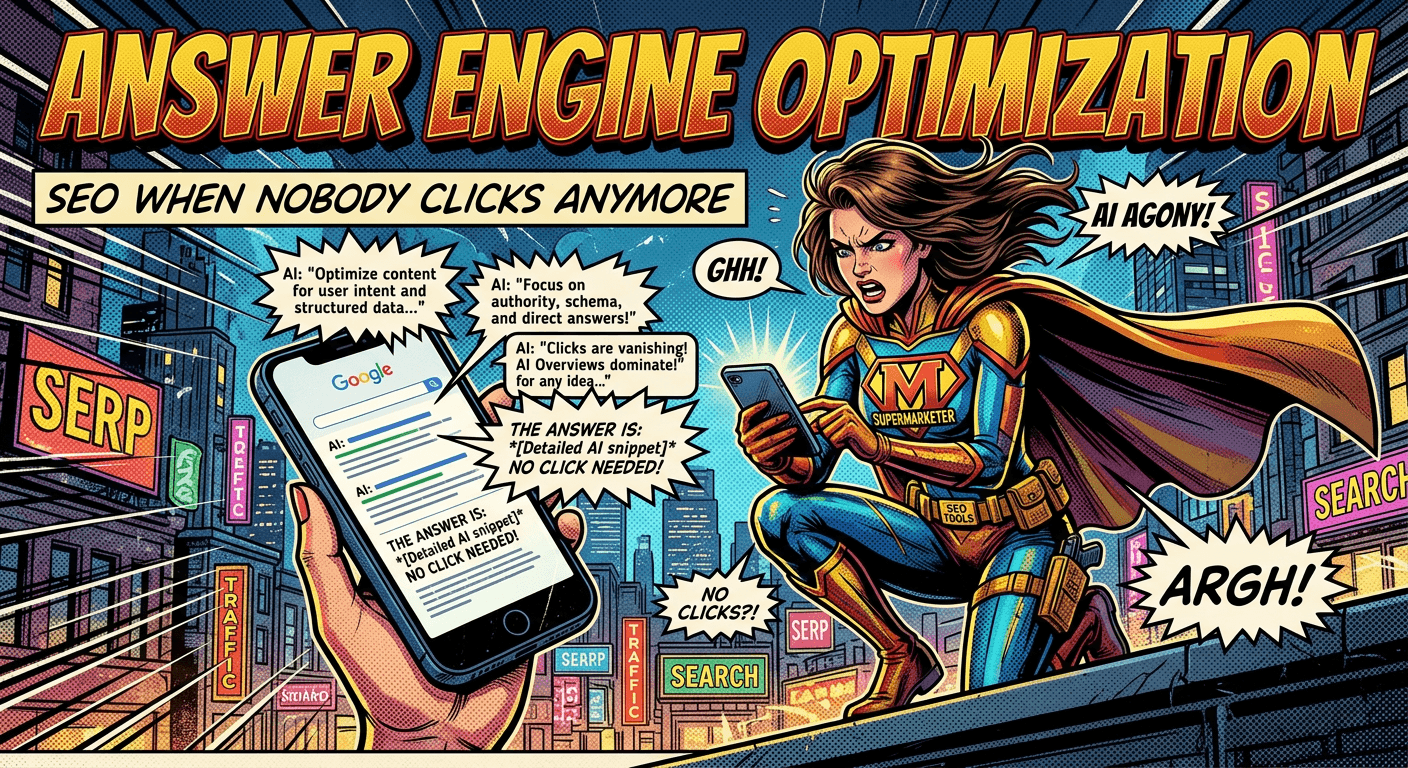
Answer Engine Optimization: SEO When Nobody Clicks Anymore
Kwame Sarkodee-Adoo
Editor-in-Chief
Answer Engine Optimization: SEO When Nobody Clicks Anymore
You spent six months climbing to position one. Confetti was thrown. Your SEO report had more green arrows than a Robin Hood convention. Then you checked Google Analytics and—wait, where did everyone go?
Welcome to the plot twist of modern search: you can win the ranking game and still wonder where the traffic went.
Google used to be a friendly traffic director. You optimized, you ranked, they sent visitors. Everyone won. Now? Google is more like that friend who asks to borrow your notes, memorizes them, then recites them to the class before you get a chance to speak. Your 3,000-word guide becomes three bullet points. Your carefully crafted analysis becomes a footnote in someone else's presentation.
The click never happens. The visitor never arrives. The conversion stays theoretical.
This isn't a bug. It's an evolution.
The Zero-Click Plot Twist
Let me tell you about Sarah.
Sarah runs a B2B software company. She invested $40,000 in SEO last year. Content strategy, technical audits, link building—the full buffet. In January, her "best project management software" page hit position one. The team celebrated with cupcakes.
By June, traffic from that keyword dropped 60%.
Same ranking. Better position. Fraction of the clicks.
What happened? Google added an AI Overview that answered the query in four sentences. Then a People Also Ask box that expanded like a well-fed accordion. Then video results. Then a shopping carousel. Sarah's #1 ranking was now living in the digital equivalent of a basement apartment—technically there, but nobody was visiting.
Her SEO agency's response? "You're still ranking #1! Visibility is valuable!"
Sarah learned a hard lesson: visibility without visits is like a billboard in a forest. Technically impressive, practically useless.
Why Google Changed the Rules
Here's the strategic reality: every click away from Google is a click that doesn't generate ad revenue on their platform. Their business model evolved. They no longer want to send traffic to your website. They want to keep users on Google, showing ads, generating impressions, maximizing engagement.
The AI Overview isn't a villainous feature—it's a strategic moat.
When Google summarizes your content and displays it without a click, they're using your expertise to enhance their product. You did the research. They provide the convenience. You get attribution (which is better than nothing, even if it feels like a participation trophy).
It's clever, really. They've turned the entire internet into a knowledge base for their AI.
What Answer Engine Optimization Actually Means
Traditional SEO asks: "How do I rank #1?"
Answer Engine Optimization asks: "How do I get cited in the answer?"
The goal isn't just the click anymore. The goal is presence. Being the source. Being the brand that Google's AI references when it generates responses. Because even if users don't click immediately, they still see your name. Still absorb your authority. Still register you as the expert.
This is SEO for the age of instant answers.
How to Optimize for Answers, Not Just Clicks
Stop Writing for Keywords. Start Writing for Questions.
Google's AI doesn't think in keywords—it thinks in intent. "Best CRM" is a keyword. "What's the best CRM for a 12-person real estate team that needs Zillow integration and mobile apps?" is a question. The AI understands questions. It generates answers from content that addresses specific situations, constraints, and contexts.
Your content needs to answer the questions people actually ask. Not the sanitized keyword versions. The messy, specific, real-world versions that start with "How do I..." and "What's the best way to..."
Structure for Extraction.
Google's AI loves structure. Headers, lists, tables, definitions. Content formatted for easy parsing gets cited more often. That beautifully written narrative blog post? The AI might admire your prose, but it prefers your FAQ section.
Think like an information architect. Clear hierarchy beats creative flourishes when machines are doing the reading.
Own the Long Tail of Specificity.
Generic queries get AI Overview treatment. Specific queries still need sources. "What is marketing?" gets summarized. "How do I set up conversion tracking for a Shopify store using Google Tag Manager when I have a custom checkout with three payment gateways?" needs detailed instructions.
The more specific and technical your content, the less likely it is to be replaced by an AI summary. Become the definitive source for narrow, complex topics that resist simplification.
Build Brand Authority Signals.
When Google's AI cites sources, it prefers recognizable brands. Unknown sites get overlooked even if their content is superior. Your brand needs to exist beyond your website.
Press mentions. Podcast appearances. YouTube presence. Industry discussions where people reference you. These signals tell the AI you're a legitimate authority worth citing.
Embrace the Citation.
Even when you don't get the click, getting cited in an AI Overview is valuable. Users see your brand name. They register you as an expert. When they eventually need deeper information—or when the AI overview isn't quite enough—you're the source they remember.
Track citations, not just rankings. Use tools that monitor AI Overview appearances. Measure brand mentions in generated answers. This is your new success metric.
The Platforms Beyond Google
Here's what makes this extra interesting: Google isn't the only answer engine anymore.
ChatGPT answers questions without ever touching Google. Perplexity cites sources while providing summaries. Claude handles complex queries with referenced responses. TikTok serves how-to content directly in-app. YouTube is the second-largest search engine and keeps traffic happily internal.
Your answer engine optimization strategy needs to span platforms.
Create content that works in ChatGPT's citation model. Build video content for YouTube's recommendation engine. Participate in Reddit discussions that Perplexity sources. Be present where answers are generated, not just where they're traditionally searched.
The New Reality of Modern SEO
There's something fascinating about spending years learning to optimize for Google's algorithm, only to watch that algorithm become sophisticated enough to provide answers directly.
We built careers on understanding how to work with search engines. We wrote the content they indexed. We structured our sites for their crawlers. We played by their rules.
And the evolution? "Thanks for building this knowledge base. We'll make it more accessible now."
The platforms we optimized for are now competing to serve users faster. Google, ChatGPT, Perplexity—they all need quality content to function, and they're all working to reduce friction for users.
We're not being replaced. We're being referenced differently.
Your 90-Day Answer Engine Pivot
Month 1: Audit Your Extraction Value
Look at your top 20 pages. Which ones answer specific questions? Which ones provide unique data or analysis? Which ones could be easily summarized by AI?
The easily summarized content needs to evolve. Add depth. Add specificity. Add tools, calculators, interactive elements that can't be extracted into bullet points.
Month 2: Build Citation Tracking
Set up monitoring for AI Overview appearances. Track when your brand gets cited in ChatGPT responses. Measure mentions in Perplexity answers.
These are your new leading indicators. Rankings are still useful. Citations are increasingly important.
Month 3: Diversify Your Answer Presence
Create content for platforms that generate answers. YouTube videos that answer specific questions. Reddit posts that demonstrate expertise. Podcast appearances that build brand recognition.
Be everywhere answers come from, not just on your own website.
The Bottom Line
Answer Engine Optimization isn't about fighting the trend. It's about adapting to it.
Google will keep summarizing. AI will keep providing instant answers. Zero-click searches will keep growing. You can't stop the evolution. You can only evolve with it.
The marketers who thrive will be the ones who figure out how to be valuable even when they don't get the immediate click. The ones who build brand authority that persists across platforms. The ones who create content too specific, too technical, too valuable to be replaced by a four-sentence summary.
SEO isn't dead. It just got more sophisticated.
And a lot more interesting.
Sources:
- SparkToro Zero-Click Search Studies
- Google AI Overview expansion data
- ChatGPT citation behavior analysis
- Perplexity source tracking research
Sources
This article was based on reporting from SparkToro, Google, Search Engine Journal. All claims have been independently verified.
About This Article
Research: AI tools monitored news sources; stories selected and verified by editors
Writing: AI-generated draft, extensively edited and enhanced by Kwame Sarkodee-Adoo
Fact-Checking: All claims verified against reputable sources
Published: August 6, 2026
🤖 We believe in transparency. Learn about our editorial process →
Join the Conversation
Stay ahead of the AI curve
Get the latest AI insights delivered straight to your inbox. No spam, just intelligence.